Give an overview of the nominee’s story. Describe how the nominee demonstrated courage, determination, perseverance and an unwavering spirit to inspire through sport. Please include timelines for the story. (750 word maximum)
Amber-Joy Boyd of Regina has built her life in sport around a simple belief: a disability should never decide who gets to play. Amber-Joy lives with albinism and low vision, and she has spent fifteen years proving that belief — first for herself, and now for dozens of athletes across Saskatchewan.
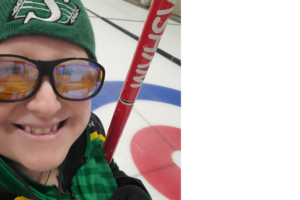
Her blind-sport journey began in 2011, when she started blind bowling, blind curling, and blind golf. She bowled for a decade, until 2021, and in 2018 she won the Saskatchewan ladies B3 blind golf championship. Before the pandemic, she had already earned her coaching certifications in both curling and goalball.
In 2012, she took up dragon boating with Outta Sight, Saskatchewan’s first blind and partially sighted dragon boat team, started by the Prairie Dragons Paddling Club. What began as a seat in that boat became a calling. After the pandemic she progressed from paddler to assistant coach to coach, earning her dragon boat coaching certification a few years ago and her Dragon Boat Canada officials certification in 2024. Today she leads the very club that first put a paddle in her hands — she has been President of the Prairie Dragons for three years — and she has served as President of the Regina Dragon Boat Festival for two years, championing inclusive paddling, including para dragon boat programming.
At the same time, Amber-Joy has been rebuilding blind sport in Saskatchewan from the ground up. As President of the Saskatchewan Blind Sports Association (SBSA), she coaches blind curling as a national-level skip, and she has started goalball again in Saskatchewan, building a weekly Regina program where new blind and low-vision athletes can learn the sport — some of them touching a goalball for the first time. She shows up every Sunday as coach, organizer, driver of equipment, and chief encourager.
Her perseverance is personal, too. In 2026 she committed to her own health alongside her athletes’, losing more than 30 pounds while training, coaching, working full-time in vision rehabilitation, and studying Vision Rehabilitation Therapy. Courage, for Amber-Joy, looks like this: show up, do the unglamorous work, and make room for the next person. Through sport, she has turned the barriers she faces every day into open doors for others.
How did the nominee grow as an individual? (500 word maximum)
When Amber-Joy took up blind sport in 2011, sport was something she joined. Over fifteen years, it became something she leads. The growth happened step by step: from athlete, to certified coach in curling and goalball before the pandemic, to dragon boat coach and certified official after it — each step making her responsible for the safety and development of whole teams, not just herself.
That growth carried into every part of her life. Coaching athletes who are blind taught her patience, clear communication, and trust. Leading three volunteer organizations taught her administration, fundraising, and how to keep going when the answer is no. She went from receiving support as a low-vision athlete to providing it — professionally, through her work in vision rehabilitation and her graduate studies, and personally, by founding community groups like the Regina Blind Supper Group, so that no one eats alone because of a disability.
Most of all, she has grown into a person who measures success by who else gets to participate. Her own confidence was built one practice at a time; she now spends her Sundays building that same confidence in others.
List any other information that may strengthen your nomination. (500 word maximum)
Amber-Joy currently serves as President of the Prairie Dragons Paddling Club (for the past three years), President of the Regina Dragon Boat Festival (for the past two years), and President of the Saskatchewan Blind Sports Association, and as secretary of the Regina chapter of the Canadian Council of the Blind (CCB). She hosts the CCB’s Getting Together with Technology group and runs CNIB’s 30 Club employment group. She is a certified coach in curling and dragon boating, working on her community coaching in goalball, and a certified Dragon Boat Canada official (2024). Her programs run on volunteer power and persistence: Sunday blind curling and goalball seasons in Regina, winter pool paddling, and an annual dragon boat festival in Wascana Park.
Her advocacy reaches just as far. She sits on the City of Regina’s Disability Reference Group, takes part in CNIB advocacy at both the local and national levels, and is active in the Canadian Council of the Blind’s advocacy group and women’s group. She is also learning American Sign Language on her own time, to make her programs more welcoming to Deaf and hard-of-hearing participants.
Few nominees touch so many corners of Saskatchewan’s amateur sport community in a single year — as athlete, coach, official, and administrator — all while living with the same disability as the athletes she serves.
Give an overview of the nominee’s story. Describe how the nominee demonstrated courage, determination, perseverance and an unwavering spirit to inspire through sport. Please include timelines for the story. (750 word maximum)
Ryan Riehl has overcome significant medical challenges in his life. At the age of ten, he was diagnosed with a Transitional Meningioma tumor growing on his optic nerves. This finding began a lifelong medical journey for Ryan. Regardless of available treatments and multiple surgeries, within a few years Ryan lost his site and was blind.
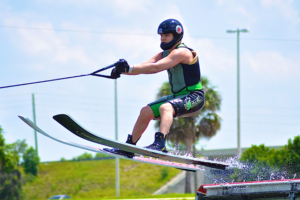
It was at this time in his life that he became involved with Blind Sports. It started with goalball, bowling, and competitive downhill skiing. Then in 2007, Waterski and Wakeboard Saskatchewan hosted a clinic to help individuals with disabilities get involved in waterskiing. Ryan was invited to a man-made lake in the north end of Saskatoon to give waterskiing a go. He described the experience as amazing and was immediately hooked on the sport.
Under the guidance of coaches David Wassil and LeRoss Calnek, Ryan began training at the Saskatoon Waterski Club. Later that same year, he competed at a disabled waterski championship in Winnipeg putting up scores in trick and slalom as Canada’s first blind water-skier. By 2009 Ryan was a 3-event skier (Trick, Slalom, and Jump) and part of the Canadian Adaptive Waterski Team. His first international event was in Vichy France, where he earned 4 bronze medals for Canada. That was the first time Canada had ever received medals in the blind category at the World level.
Ryan continued downhill skiing in the winters and waterskiing in the summer until 2015. He was competing in Slalom racing at the 2015 Canada Winter Games in Prince George British Columbia when he started complaining of tiredness and chest pain. Upon return to Saskatoon he was admitted to hospital and subsequently transferred to Edmonton where he underwent open heart surgery. Despite this setback Ryan persisted. He underwent cardiac rehab and began training again. He was determined to return to waterskiing – the sport he loved, and by the summer of 2016 he was back on the water.
By 2018 Ryan’s hearing became affected, and again after enduring surgery and a cochlear implant, he also lost his hearing. This brought forward many more challenges as his balance was now affected and communication with coaches was slow and time consuming. He continued to ski at the world level but with no deaf/blind category in place, he remained in the blind category making argument for additional time lenience whenever the opportunity arose for him to speak his case. For example, the equipment in place for blind slalom skiers to know when they rounded a buoy was no longer useful as he could not hear the horn. His coach came up with a tactile method of notification which Ryan didn’t always feel in his rope handle.
Despite loosing these two senses Ryan had a successful 20+year career as a 3-event waterskiier who represented Canada at the world level. He was a member of the Canadian Adaptive Waterski Team and has been on the podium representing Canada at numerous world events. He was Waterski and Wakeboard Canada athlete of the year in 2010, 2012, and 2022. Unfortunately, he was forced into retirement in 2024 following spinal cord surgery to repair scaring and degenerative changes to his spine. He remains active in the waterski community and is a great ambassador of the sport.
How did the nominee grow as an individual? (500 word maximum)
Being blind and deaf is a very limiting disability, yet Ryan continues to be a great ambassador for the sport of waterskiing. He was a very dedicated and motivated athlete who acknowledges the assistance he received from his coaches and teammates over the years. Their support allowed him to be successful and experience the camaraderie of the National Adaptive Team and participate in events all over the world. He always said that waterskiing gave him purpose.
Over the last 4 years Ryan has been sharing his experiences through Zoom and in person talks with schools and community groups across Saskatchewan. He highlights waterskiing as the main motivator in living with his disabilities.
List any other information that may strengthen your nomination. (500 word maximum)
Ryan began painting in 2019 and mostly enjoys painting trees. He says when trees are standing together, they look strong and healthy and support each other.
In 2024 he did a collaboration with Glen Scrimshaw Titled “Champions Together” with the proceeds from that painting and prints going to support his waterskiing adaptive teammates to get to worlds in 2025.
Ryan also finds joy in making tactile wooden board games and shares his works with other blind/deaf individuals. He believes with support and encouragement that deaf/blind individuals can have a sense of belonging and community.
The media link within Ryan’s website below gives some visual explanation to the challenges of skiing deaf and blind as well as his accomplishments over the years in the sport.
Nominee Supporting Documents
Nominations can be accompanied by supporting documents about the nominee or competitions. A maximum of three documents can be uploaded or links pasted below.
Give an overview of the nominee’s story. Describe how the nominee demonstrated courage, determination, perseverance and an unwavering spirit to inspire through sport. Please include timelines for the story. (750 word maximum)
Kevin’s achievements as a coach, manager and team organizer in the First Nations sports world are numerous, winning several FSIN provincial championships in youth hockey, youth softball, youth volleyball, youth golf, adult golf, adult volleyball, adult slo-pitch and adult recreational hockey. The FSIN Provincial Championships are provincial events sanctioned by the various sports governing bodies in Saskatchewan.
Kevin has extensive experience in hosting FSIN Provincial championship events over the years, including the 2023 FSIN Adult Hockey Championships, 2019 FSIN Softball Championships, 2016 FSIN Youth Volleyball Championships, 2015 and 2013 FSIN Youth Hockey Championships. Under his leadership as the Games Manager, his community successfully-hosted the 2024 and 2001 Saskatchewan First Nation Summer Games both in Lac La Ronge, Saskatchewan.
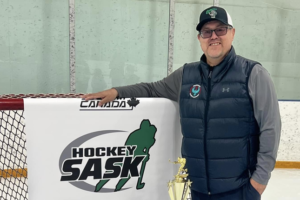
Over the years, he has served in numerous capacities including board member and vice-president of the La Ronge Junior A Ice Wolves hockey club. Currently he is the President of the North Central Minor Hockey League, made up of 21 teams from around northern Saskatchewan.
Kevin is Director of the JRMCC Sports & Recreation Department, which is a leader in First Nations sports and recreation. The Department owns and operates a $19 million sports facility with a $2 million annual operating budget. The facility includes a community hall/gymnasium, arena, fitness centre, running track, ball diamonds, outdoor canteen and provides outdoor equipment rentals. Under his guidance, the recreation facility, the Jonas Roberts Memorial Community Centre (JRMCC), was the recipient of the Facility of the Year as awarded by Saskatchewan Parks & Recreation Association. His staff of 10 help keep the doors open 52 weeks a year.
Every year, the department also hosts the 10-day Lac La Ronge Winter Festival, Northern Saskatchewan’s premiere winter event and one of the largest events of its kind in the province.
For youth, the department coordinates local athlete participation in the Tony Cote Summer and Winter Games. Department staff also runs several local rec hockey, volleyball and slo-pitch tournaments for adults throughout the year.
Away from his community, Kevin was a founding director of the Indigenous Sports Academy (ISA) Eagles, a high-performance hockey program for Indigenous youth based in Saskatoon. Sanctioned by Hockey Saskatchewan and Hockey Canada, the vision of ISA was to create meaningful opportunities for Indigenous youth through sports and education. In 2021, the program’s first year of operation, the U17 team ran as an independent program playing exhibition games and tournaments throughout western Canada. In their second year, ISA was accepted as the 26th program into the Canadian Sports School Hockey League (CSSHL) and is the only one of it’s kind in all of Canada.
Kevin also coordinates the ISA’s annual minor hockey tournament, the Western Canadian Challenge Cup. This all-Indigenous tournament is held in Saskatoon in May of every year and brings together approximately 60-70 teams per year in divisions ranging from U9 to U18. The event has quickly become the premiere Indigenous youth hockey event in the province.
How did the nominee grow as an individual? (500 word maximum)
Kevin grew up on the reserve in Lac La Ronge and began his love of sports while attending the Prince Albert Indian Student Residence at a young age. His experience in the residential school allowed him to participate in organized sports, his favorites being hockey, soccer and wrestling. In just his third year of minor hockey, his team PAISEC (now known as the Prince Albert Indian Student Education Centre) Blues won the Peewee Tier II Provincial Championship in 1988.
Once the school year ended, he retuned home to the reserve to attend junior high. Unfortunately, moving home eventually meant the end of his hockey career as his parents could not afford equipment and fees to continue playing. Through this specific experience alone, he has chosen to try make a difference for First Nations youth.
Through his role as Director, he has developed policies in the organization that provides financial support for sports fees and equipment. Known as the 4A Fund (Athletics, Arts, Adolescent & Adult Skills Enhancement), the purpose of the fund is to provide athletic, artistic, adult sporting & recreational funding opportunities to the members of Lac La Ronge Indian Band (LLRIB) who resides on or off reserve under the administration of La Ronge. In doing so, the developed purpose is to promote health, wellness, and development for the members of LLRIB while ensuring fair and equitable access to financial assistance. Members of LLRIB who participate in athletic, artistic, adult sporting & recreational activities or training are most likely to promote a healthy community. Thus, the purpose of the fund is aimed at promoting overall health and wellness.
List any other information that may strengthen your nomination. (500 word maximum)
In 2005, Kevin was awarded the Saskatchewan Centennial Medal for his contributions to his community. He was one of founders of the Lac La Ronge Arena Fund, an organization that fundraised for the newly built JRMCC Arena on the reserve. These funds helped purchase hockey nets, a new score clock, a new Zamboni, a new sound system and some new equipment for Minor Hockey. He was also awarded the Queen Elizabeth II Platinum Jubilee Medal in 2022. In 2024, at their awards gale, the La Ronge & District Chamber of Commerce awarded Kevin with the Employee of the Year award.